Watagan Park: the story behind the development
In recent months a number of questions and comments have appeared on social media regarding the long-term development of the Avondale Estate. Some of these discussions highlight that many members may not be familiar with the background, purpose and process behind the Watagan Park development.
This article aims to provide a brief overview of how the development came about, the steps taken along the way and the reasons the Church chose to pursue this path. It has been prepared by Dr Barry Oliver, who served as Secretary and later President of the South Pacific Division during much of the early planning for the project.
Because the development spans more than two decades and involves many stages, this overview is not intended to be comprehensive. Rather, it seeks to outline the key decisions and processes that have shaped the project.
Early considerations
Between 2000 and 2003 consideration was being given to how a large portion of land held by the South Pacific Division for use by Avondale College could be utilised to help secure the institution’s financial future.
At that time Lake Macquarie Council had placed a moratorium on rezoning land while it prepared a new Local Environmental Plan (LEP). In the original draft of the Council’s LEP, the North Cooranbong land area—now known as Watagan Park—was zoned in a way that would have prevented future building or development. Church leaders recognised the critical importance of finding a way to intervene so that the ageing infrastructure of Avondale could be updated and the future of the college secured.
At the same time Avondale College was preparing to apply for university status. As part of that process, it was necessary to demonstrate long-term financial viability. The Avondale Flying School was operating at significant financial losses year after year and as a result the airstrip situated on part of the land was being closed, with the Avondale Flying School relocating to Cessnock Airport. In addition, sections of the land where the airstrip had been located were being used for illegal rubbish dumping by people not associated with Avondale or the Church. Lake Macquarie Council required that the rubbish be removed and that substantial funds be spent annually on bushfire mitigation.
In light of these circumstances, and after a long period of discussion, consultation with Church and government entities, and consideration of various options, Avondale College recommended to the South Pacific Division that the land be developed as a community estate through a joint venture.
Establishing the joint venture
After reviewing several options, a joint venture agreement was established between the Australasian Conference Association (the legal entity which holds Church properties in Australia) and Johnson Property Group. The purpose of the agreement was to facilitate the development of a residential community to be known as Watagan Park.
The joint venture was approved by both the Avondale College Council and South Pacific Division Executive Committee.
Given the scale and complexity of the proposed development, Church leaders determined that they did not have the experience, the capital, nor the appropriate personnel to engage in a major undertaking such as this, and that a partnership with an experienced development organisation would be necessary. Johnson Property Group had previously successfully undertaken similar projects, including work with the Greater Sydney Conference and involvement in the rezoning associated with the construction of the Clark Tower at Sydney Adventist Hospital.
Under the terms of the agreement, the Church contributed the land to the joint venture while Johnson Property Group provided managerial expertise and the capital required to pursue rezoning and undertake the development process.
Importantly, the land itself was not sold to Johnson Property Group. Rather, they carried the financial risk associated with seeking rezoning approval. The Church retained ownership of the land until individual lots were sold as part of the development, and this remains the case today.
As part of the process, additional adjoining parcels of land were purchased to support the overall development. In most cases, these parcels were placed in the name of the Church, although they were purchased with funds provided by Johnson Property Group.
Proceeds from the development were to be shared between the Church—for the benefit of Avondale College—and Johnson Property group on an agreed commercial basis.
Key stages in the development
Several key milestones occurred during the early years of the project:
- In March 2005, Johnson Property Group, on behalf of the joint venture, lodged a planning submission with Lake Macquarie Council seeking rezoning of land in the North Cooranbong portion of the estate.
- Due to the size and complexity of the proposal, Council appointed the consulting firm URS to review the submission and provide additional assessment. The costs associated with this review were met by Johnson Property Group. Additional due diligence was conducted to ensure the viability and security of the proposed joint venture agreement, particularly during the Global Financial Crisis.
- In December 2008, the rezoning application and concept plan for the development were approved by Council.
- In April 2009, development consent was granted for the first subdivision of Church land.
- In 2011 construction work commenced on the site.
- Over the past 14 years, a total of 1,103 residential lots have been officially registered.
Council requirements and community infrastructure
When approval to develop the land was granted, Lake Macquarie Council imposed a number of requirements on the joint venture.
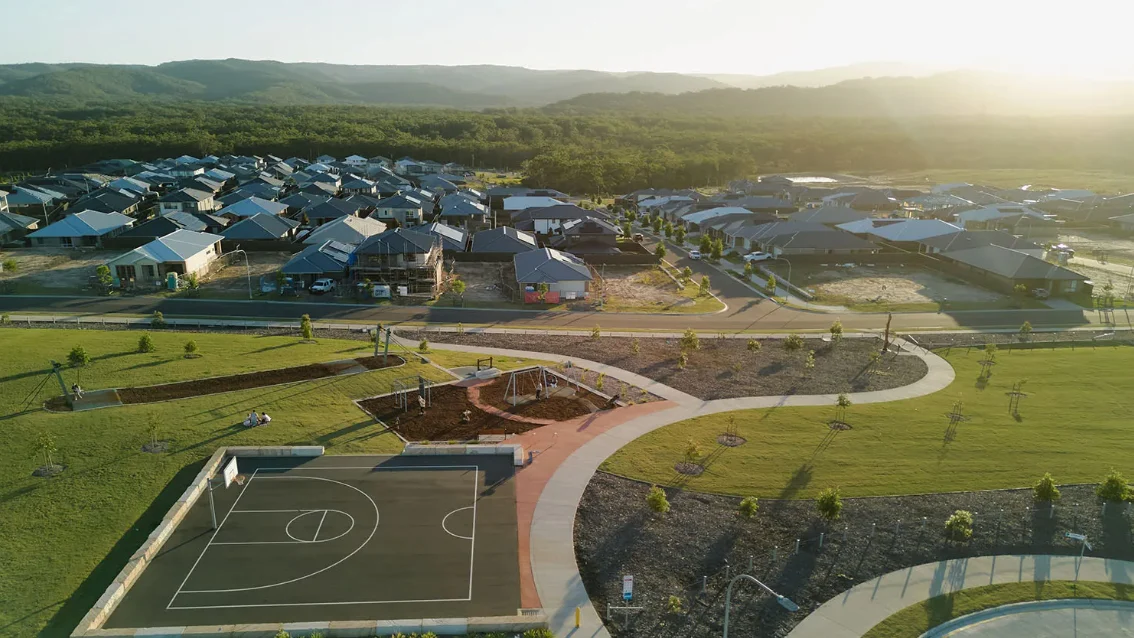
These included the installation of traffic lights at several intersections in Cooranbong, upgrades to local roads, the provision of bicycle and walking tracks, sporting fields and playgrounds, as well as a shopping centre that would include a medical centre, and eventually a public school.
Approximately 90 per cent of the costs associated with these infrastructure requirements will have been met by the halfway point of the development. As a result, income from the later stages of the project is expected to increase significantly.
Environmental and site remediation work
A range of environmental measures have also been incorporated into the development through the joint venture partnership.
These include retaining more than 30 per cent of the land as green space and establishing tree-planting guidelines for both residential areas and shared spaces.
A state-of-the-art water recycling system has also been installed. Waste water from Watagan Park is treated and reused locally rather than being discharged into ocean systems. This approach means residents are less affected by water restrictions during times of drought. As a result, plants and trees are more likely to survive dry periods.
Significant remediation work has also been undertaken to address contamination on the land associated with historical earthworks and filling practices. More than 200 truckloads of illegally dumped waste have been removed from areas within Watagan Park and the Avondale School site.
The joint venture has also worked with Lake Macquarie Council to ensure developer contributions generated by the project are directed toward infrastructure benefiting the Cooranbong area. Initially, the Council sought to redirect a significant portion of these funds to other areas within Lake Macquarie, such as Speers Point and Warners Bay. The joint venture secured an agreement that infrastructure funded by these contributions would be delivered when the community needed it, rather than being subject to lengthy delays.
Structure and oversight of the joint venture
The joint venture agreement includes several governance and accountability measures.
- The agreement was signed in March 2004.
- The South Pacific Division contributed the land at an agreed valuation.
- Johnson Property Group provided the capital required to pursue rezoning and development, carrying the significant financial risk associated with this stage of the project.
- Oversight of the joint venture is provided through a Project Control Group consisting of five members—three representing the South Pacific Division and two representing Johnson Property Group. This structure ensures that the Church retains majority oversight of decisions relating to the direction of the joint venture and Watagan Park.
- Johnson Property Group provides the finance and expertise for site works and infrastructure, carrying the financial risk until residential lots are sold.
- Additional adjoining parcels of land have been purchased by Johnson Property Group to support the development and now form part of the joint venture.
- Development expenses can be recovered from land sales associated with each stage of the project, but only to the extent of the income generated from those sales.
- Under the agreement Johnson Property Group cannot receive profits from the development before the South Pacific Division does.
- Until recently all profits have been reinvested into the development itself, helping to reduce borrowing costs and increase long-term return.
- The joint venture accounts are audited annually. These results are incorporated into the Division Property Trust accounts, which are also audited and reported to several Church boards.
- The joint venture is also subject to internal audit processes conducted by the South Pacific Division.
Outcomes to date
The Watagan Park development has now been underway for more than a decade.
As reported recently in the Adventist Record, Avondale will receive $50 million from the Seventh-day Adventist Church over the next five years to help secure its future as a university. The investment has been made possible through a proposal developed by the South Pacific Division involving the Division’s purchase of future entitlement to proceeds from the Watagan Park development. The $50 million was based off current valuations of the project and enabled Avondale to receive their profits upfront, without having to wait until the joint venture is finalised.
In addition to supporting the long-term future of Avondale, the development has provided housing for hundreds of families and contributed to the growth of the Cooranbong community. Avondale School has experienced increasing enrolments, and the presence and influence of the Church in the area have continued to expand.
Looking ahead
Projects of this scale often span many years and involve complex planning processes. It is understandable that questions may arise, particularly when the original decisions were made some time ago.
By sharing some of the background and process behind the Watagan Park development, it is hoped that members and the wider community can better understand the intentions and outcomes of the project.
At its heart, the development has been undertaken with a view to supporting the long-term mission of Avondale University and the work of the Church in the region.